
Nvidia’s CES 2025: AI and Gaming Redefined

Nvidia has once again proven why it remains a titan in the tech world. CEO Jensen Huang delivered a dynamic keynote address at CES 2025. In front of a packed audience in Las Vegas, the 61-year-old unveiled a series of game-changing technologies. Specifically, these ranged from next-generation gaming GPUs to innovative AI models designed to train robots and autonomous vehicles. Over two electrifying hours, Nvidia outlined its ambitious vision for 2025, setting a high bar for the annual tech conference.
Gaming Revolution: RTX 50-Series GPUs
A major highlight of the keynote was the unveiling of Nvidia’s latest GPU line-up, the RTX 50-series. Built on the ground-breaking Blackwell architecture, these GPUs promise unprecedented performance gains over their predecessors. The series includes four models: the RTX 5070, RTX 5070 Ti, RTX 5080, and the flagship RTX 5090, with estimated pricing ranging from £450 to £1,600.
The RTX 5090, Nvidia’s most powerful GPU to date, has a compact size compared to the RTX 4090 while packing an increased power output of 575 watts. This design evolution also incorporates cutting-edge features like GDDR7 memory, 3D vapour chambers, and DisplayPort 2.1b connectors. These support 8K resolution at 165Hz, delivering exceptional visual performance. Laptop versions of these GPUs will debut in March, heralding a new era of portable gaming power.
To showcase the RTX 50-series, Huang presented real-time demos of RTX Neural Materials, RTX Neural Faces, and DLSS 4. This iteration of Nvidia’s Deep Learning Super Sampling introduces Multi Frame Generation, delivering up to three AI-generated frames per traditionally rendered frame. This enhances frame rates by up to 8X, redefining gaming visuals and performance.
AI for Robots and Autonomous Vehicles: Cosmos Foundation Models
Nvidia also introduced the Cosmos AI models, a revolutionary tool for generating photorealistic videos to train robots and autonomous vehicles. By using synthetic data, companies can significantly reduce the costs associated with collecting real-world data. Cosmos’ ability to simulate environments governed by the laws of physics has far-reaching implications for robotics and industrial AI.
Huang emphasised the importance of this innovation: “We are going to have mountains of training data for autonomous vehicles.” However, he noted that real-world data collection remains integral. Released under an open licence, Cosmos aims to democratise access to advanced AI training tools. This innovation is expected to have an impact akin to Meta’s Llama 3 on enterprise AI, empowering industries to accelerate innovation.
Introducing Project Digits: Nvidia’s First Desktop Computer
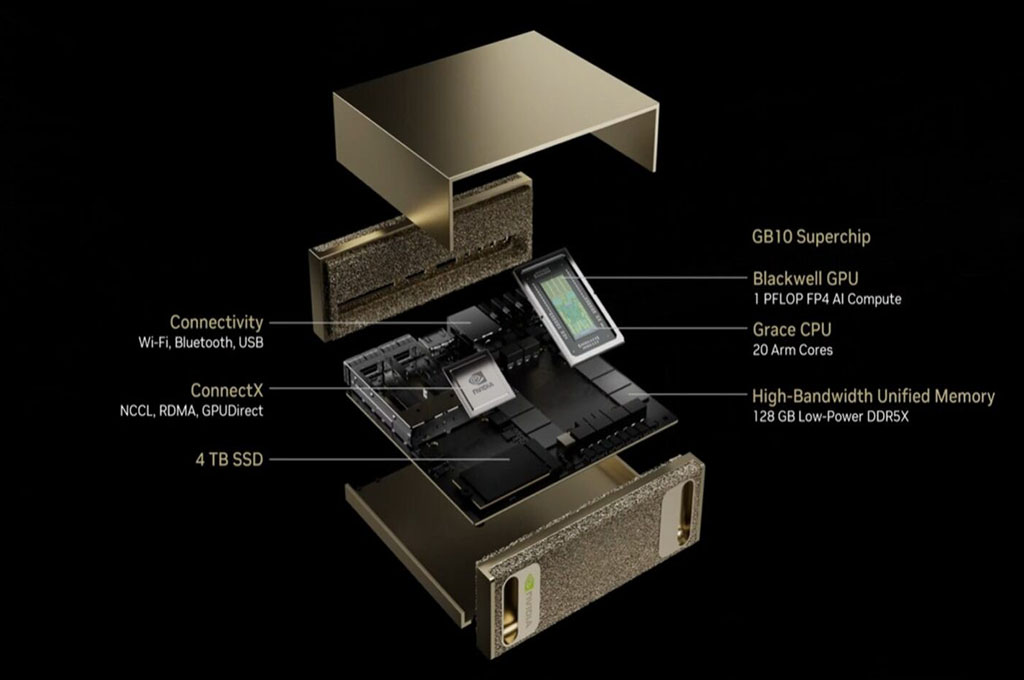
In a historic move, Nvidia unveiled Project Digits, its inaugural desktop computer designed for AI researchers, data scientists, and students. Estimated Pricing at around £2,400, Project Digits features the GB10 Grace Blackwell Superchip. This delivers unparalleled computing power for running and fine-tuning AI models up to 200 billion parameters. Operating on a Linux-based platform, this versatile machine combines the capabilities of a workstation and a cloud computing hub, making advanced AI research more accessible.
Nvidia highlighted Project Digits as a cornerstone for AI innovation. Huang described it as “a cloud computing platform that sits on your desk,” offering researchers a seamless experience for developing and testing complex AI systems. With its release slated for March 2025, this product aims to redefine the boundaries of desktop computing.
Llama Nemotron: Open-Source AI for Enterprises
Expanding its AI portfolio, Nvidia introduced the Llama Nemotron family of models, built upon Meta’s Llama framework. These open-source large language models (LLMs) are tailored for enterprise use. They allow businesses to deploy AI agents effectively, handling tasks like customer support, fraud detection, and optimising supply chains. Available in Nano, Super, and Ultra configurations, Llama Nemotron balances performance, accuracy, and latency, catering to diverse business needs.
Companies like SAP and ServiceNow are already integrating these models into their operations, demonstrating their potential to streamline processes and enhance productivity. Nvidia has also made these models available for download via build.nvidia.com and Hugging Face, ensuring easy accessibility for businesses of all sizes.
Mega: The Future of Warehouse Robotics
For the logistics and supply chain sector, Nvidia debuted Mega, an advanced robotic fleet management software. Mega allows various types of robots—from Autonomous Mobile Robots (AMRs) to humanoids—to work collaboratively in warehouses. By integrating Nvidia’s Omniverse and Isaac technologies, Mega enables the creation of digital twins. These twins streamline the development, testing, and deployment of robotic systems, reducing complexity while enhancing scalability.
Early adopters like Germany’s Kion Group are already leveraging Mega to optimise workflows and boost operational efficiency. With its software-defined capabilities, Mega is set to revolutionise warehouse operations, providing businesses with unmatched control over their robotic ecosystems.
Autonomous AI Game Characters
Building on its Ace technology, Nvidia introduced autonomous AI-powered game characters capable of perceiving, planning, and acting like human players. These characters are powered by multi-modal small language models that interpret audio cues and environmental inputs. Nvidia announced partnerships with developers to integrate these autonomous characters into popular games, including PUBG: Battlegrounds and Naraka: Bladepoint.
Additionally, Nvidia’s AI virtual assistant, G-Assist, will soon be available to GeForce RTX users. This innovative feature promises to enhance player engagement by providing immersive support and interactions during gameplay.
Record-Breaking Momentum
Nvidia’s ground-breaking announcements come at a time of unparalleled growth for the company. Moreover, riding the wave of AI demand, its shares recently closed at a record $149.43, propelling its market cap to $3.66 trillion. As the world’s second-most valuable company, trailing only Apple, Nvidia is poised to remain at the forefront of technological innovation.
Conclusion
Jensen Huang’s CES 2025 keynote was a tour de force, showcasing Nvidia’s commitment to shaping the future of AI, gaming, and robotics. From the cutting-edge RTX 50-series GPUs to transformative AI models like Cosmos and Llama Nemotron, Nvidia continues to push the boundaries of what’s possible. As these innovations roll out in the coming months, the tech world will undoubtedly be watching closely.